case study
Integrating Caterpillar Marine Propulsion and Genset packages with Berg Propulsion Hybrid System for Next-Generation Hybrid Harbor Tugs
The Limits of Conventional Mechanical Propulsion
Harbor tugs are among the most demanding working vessels in commercial maritime. They operate at high torque loads, log significant engine hours, and require propulsion systems capable of immediate, precise response. A customer approached Thompson Marine with the realization that conventional mechanical propulsion was becoming increasingly expensive to maintain and increasingly difficult to align with emerging emissions expectations. The customer understood that full battery-electric propulsion was and is still not fully proven at scale for harbor tug duty cycles, but wanted to explore options. The challenge was to build a vessel that reduced emissions and fuel consumption, extended the useful life of major drivetrain components, improved overall performance, and positioned the customer’s fleet for further electrification in the future, without relying on technology that had not yet demonstrated long-term reliability in commercial service. Seabulk Towing, now Bay Towing, was that customer.
The build was a deliberate choice. Rather than waiting for full battery-electric technology to prove itself in commercial harbor tug service, the then Seabulk leadership committed to a phased approach: hybrid without batteries first, hybrid with batteries next, and full electrification in the future. Operating harbor tugs in Port Arthur, Texas, and Lake Charles, Louisiana, they needed a partner who could engineer that vision into a working vessel. Thompson Marine became that partner, engineering a propulsion system that no off-the-shelf solution could deliver. The hybrid tugs Thompson Marine powered for this customer remain some of the most advanced vessels in the fleet.
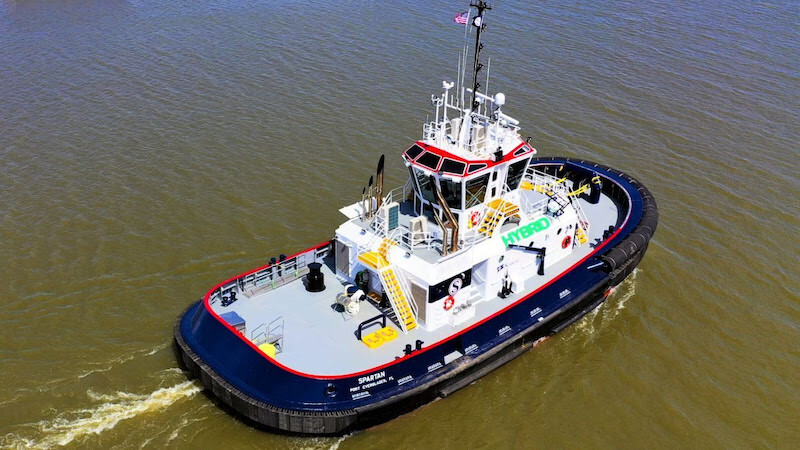
A Combined Mechanical and Electrical Propulsion Plant
Thompson Marine managed and assisted in the engineering of the hybrid mechanical/electrical propulsion system combining Caterpillar main engines, Berg Z-drives, electric drive motors, variable frequency drives (VFDs), generator sets, and a centralized switchboard. In normal operation, the generator sets power the electric motors, which drive the vessel through the Berg Z-drives during transit and standby. The Caterpillar main engines engage mechanically when full tug power is required. The hybrid’s proprietary control system design manages the entire combined plant, coordinating engine speed, clutch engagement, electric motor direction and speed, and VFD output so that mechanical and electrical power work in concert without conflict or interruption.
Engine Sizing, Overhaul Intervals, and Total Cost of Ownership
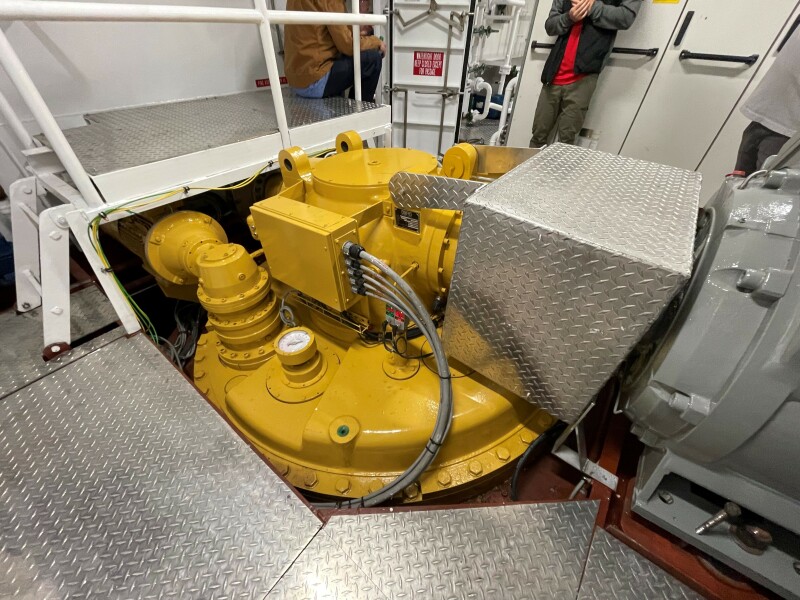
The architecture of this system has direct and measurable results regarding engine longevity, overhaul scheduling, and the total cost of ownership across the vessel’s service life. This integration allowed the customer to specify 12-cylinder main engines in place of the 16-cylinder units a conventional vessel of equivalent power would require, reducing both the capital cost of the build and the long-term cost of overhauls. Because the main engines accumulate a fraction of the hours a conventional tug would log over its service life, major overhaul intervals are projected to extend well beyond the vessel’s 30-year life expectancy at current usage rates. Generator set overhauls, which are significantly less complex and less expensive than main engine overhauls, carry the routine maintenance load instead. The result is a vessel that outperforms conventional mechanical tugs of equivalent total horsepower, driven by the instant torque response of the electric drive motors, while establishing the infrastructure for future battery integration as this technology continues to evolve.
Thompson Marine In-House Engineering at the Intersection of Caterpillar and Berg Propulsion
Delivering a system of this complexity required more than the right components. It required an engineering team with experience, the relationships, and the in-house capability to help integrate all of it. Projects of this complexity are not about product knowledge alone; they require the experience needed to design and engineer systems that span multiple technologies from multiple manufacturers simultaneously. Thompson Marine’s in-house engineering team, led by Marine Engineering Manager, Shawn Lauer, is one of the few engineering groups in the country positioned to execute this kind of work.
Thompson Marine is an authorized Caterpillar marine dealer and the exclusive authorized Berg Propulsion distributor for the United States. Having both relationships, combined with the engineering team’s expertise to integrate them at the system level, is rare in the commercial marine industry. The Thompson Marine engineering team designs custom control systems, fabricates in-house pump packages, generator sets, hydraulic power packs, and engine mounts, and manages full project integration from initial design through sea trial and commissioning. The team brings hundreds of years of combined marine experience across engineering, service, and project management, working directly alongside customers from the first conversation to long after the vessel enters service.